On Being Certain and Normal Science

This morning I went for a run, which is a newer endeavor I started up at the end of April. I mentioned my recent interest in running in a previous blog, but as a recap…about 10 years ago I ran quite a bit, I moved away from it for a variety of reasons (PhD school being one of them), and this:

Good-Running-Form

is what I imagine myself looking like when I go running. So, for about the past five weeks, I’ve run every other day. My goal is to get to a place where I can comfortably run a 5k.

During the time I’ve been running, I’ve increased my distance to the point where I am now running about 2 miles at a time. I use an app (Strava…it is free and is great! :)) to track my route, distance, and time. This morning, however, I ran much further than I have over the past several weeks. I ran 2.7 miles, and it felt good. In fact, if it wasn’t for a few service people coming to our house to fix/build some things, I probably would have continued running (me=turning into Forrest Gump).

I’m quite proud of myself for running 2.7 miles. Mostly because I woke up this morning and did not want to run. I even texted my running accountability partner about it. I just wasn’t “feeling” it, and was pretty much trying to just focus on having the whole experience over for the day.

homer_running
(This is probably much closer to what I look like when I run.)

So, you might be able to imagine my surprise when Strava told me that I had run 2.7 miles. I’ve actually experienced such surprise two other times this week (that I’m consciously aware of), and both of those have caused me to pause as well. In each of those situations, I also found myself quite certain about what it was that I was talking about and how something was going to be, and in each of those situations I found myself to be wrong. Being wrong to me, however, really isn’t much of a surprise, which is why I’ve noticed myself pausing a bit more and considering how I can own my mistake in front of the other person so that they can see that I recognize my mistake. What it has all led me to consider, though, is Thomas Kuhn and his essays captured in the book The Structure of Scientific Revolutions. I was finding myself caught up in “normal science”.

“Normal science, the activity in which most scientists inevitably spend most all their time, is predicated on the assumption that the scientific community knows what the world is like. Normal science often suppresses fundamental novelties because they are necessarily subversive of its basic commitments. As a puzzle-solving activity, normal science does not aim at novelties of fact or theory and, when successful, finds none.”

In each of the experiences I had, I was quite certain that I knew “what the world was like”, and I went into each experience with that in mind.

I was not going to like my run today. It was going to be painful, and frustrating.

And in each of these experiences I found myself curious as to why I thought I was so certain.

I really enjoyed my run, and could have kept going.

After all, I knew that there was information that I know that I don’t know, yet I found myself wanting so badly to know something, that I turned what I was aware of into the fully story. I’m pretty sure that I’m not alone in this behavior, and I’m quite confident that it will occur many more times despite my efforts for it not to. I don’t say this in an effort to not try…more to acknowledge my own imperfect self. What I can do though is to continue to recognize that there is always going to be information missing and things I don’t see, and to continually strive to be open to hearing more of and about it. I can also continue to own when I have make a mistake, as well reflection on the process of how I got to such a place originally.
Discussing Metacognition in Student Affairs

As a doctoral student at the University of Maryland, I was required to take classes toward a concentration. I knew that I wanted my concentration to be in learning and development (my true passion), but I admit that I was quite nervous to take courses outside of my degree department. Still, I kept in mind the advice I received from Sharon Parks Daloz during my first year as a student affairs professional at Longwood University. She had come to campus to speak, and I had the opportunity to drive her home, which I took full advantage of by asking her about the PhD process (I knew that I wanted to obtain a PhD, but was still in the exploration phase). I can only imagine she was exhausted when I dropped her off at the airport from the amount of questions I asked, but she was so kind and patient in responding to all of them (Thank you, Sharon!). One piece of advice that she shared that stuck with me was to, “take courses outside of the field I was interested in contributing to so as to find unique contributions/ideas/thoughts/insights.” And so this was the advice that I clung to as I entered unfamiliar classrooms in unfamiliar buildings in pursuit of my concentration.

Perhaps the course I was the most nervous about taking was a cognitive psychology course. I recall having to look on the campus map for the building, and arriving early the first day to make sure that I found the classroom. I wasn’t sure of the style of teaching I would experience, and knew that I would fail miserably at any course that was going to require rote memorization. Considering this thought now makes me chuckle a bit, given that such a teaching style would not implore all of the research contributions cognitive psychology has made to the learning process…at the time though I was unfamiliar with such contributions. I just knew that I was leaving the familiar discussion-based classroom environment of the Benjamin Building!

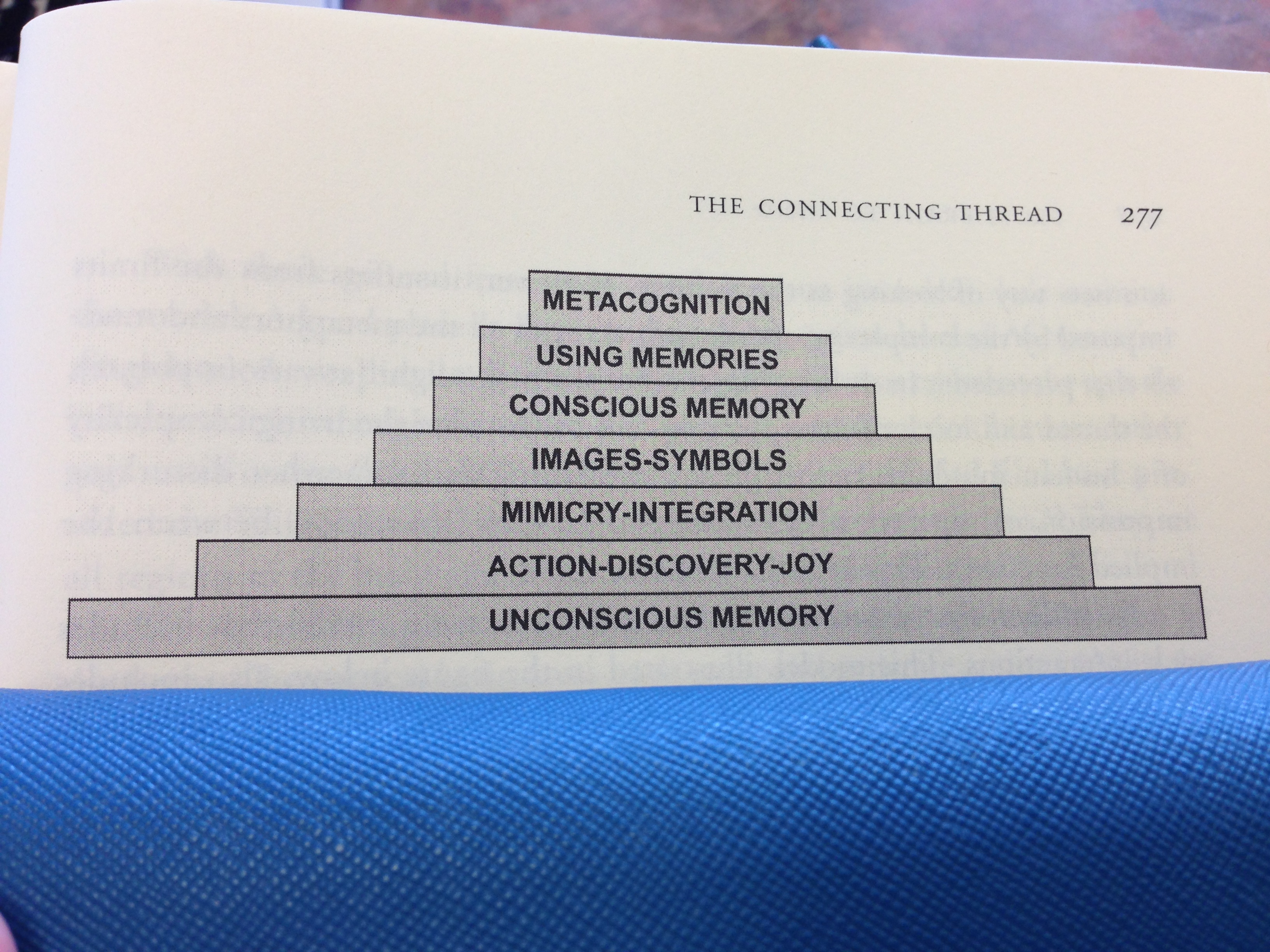
It was here in this course that I began reading articles from the field of neuroscience, and considering the physical processes of the brain such working memory, executive function, and long term memory. I could see the benefit of research conducted from a more positivist paradigm (although I did keep showing my paradigm by thinking…why try to control for so much when people don’t experience the world in such a controlled way?), as it allowed for a deeper understanding of specific details. All of this, I was encouraged to translate into what I understood to be the learning process, specifically the transformative learning process that I was exploring and writing a bit about in the field of student affairs. It was exciting as I could see the interconnections of two fields, and it added depth to what I was learning about the developmental process spoken about my theorists such as Piaget, Kegan, and Bronfenbrenner. I’ve continued post-PhD to explore as much as possible fields such a neuroscience, biology, physics, and psychology for the insights being made into the learning process. In this continued exploration, I have come to learn more about the process of metacognition, and recently came across this chart:

IMG_0545

to demonstrate the process of metacognition. James Zull (2011) included it in his most recent book titled From Brain to Mind. It is his depiction of the process one needs to experience to move from brain to mind…to reach metacognition. In the chart you would move up through the different levels. Zull goes into a detailed discussion of what it might look like to be “at” each “bar” in the chart, and I encourage you to read his book for more insight. What is hanging with me is the assertion he makes that metacognition depends on the nature of our experiences, and that these experiences must involve self-awareness. That such experience must allow the learner to integrate, “cognition, emotion, action, feelings, sensory experiences, and motor experiences” (p. 279). They must encourage the learner to draw and develop connections. It is from this that “the self emerges”, and it is allowing spaces for the learner to be them “selves” that allows for difference, that allows unique interactions with the world, and through unique interactions innovation thrives. Innovation is what many argue our world needs to continue progressing. Innovation is what many argue we need for survival.

17

So, I, like Zull, offer the above chart and my reflections here to encourage a discussion to those in the field of student affairs. What are your thoughts about how you design experiences for metacognition within the learner? What are your thoughts about involving self-awareness for the learner?

Looking Within to See What is Out There

This is the second summer I’ve had the opportunity to help guide a book club with a great colleague, Stacey, for the First Year Experience (FYE) instructors. Last year, we facilitated conversations about Ken Bain’s book, What the Best College Teachers Do. It was a pretty quick, but worthwhile, book…and not just for those teaching FYE courses (really quite a good book for anyone interesting in teaching/learning).

This year, the book we’ve selected is Parker J. Palmer’s The Courage to Teach. From what I understand it is sort of considered a classic to those that teach (my clue to this realization was the publication of an anniversary edition). I actually have already read it once, but it about 10 years ago, so am excited to be reading it again this summer.

Although the book club hasn’t officially started yet, I have begun to read the book. And in true Palmer style (I’ve read a few of his other books–which I highly recommend!) he’s got me thinking. Sometimes I think that he has some sort of magical power that enables him to speak directly to what I’ve been ruminating on the most. This was at least my experience this week (and has been my experience many times in the past). Since the school year has come to a close, and I’ve actually found myself experiencing a bit more stress free environment, I’ve been spending a lot of time consider how I see myself in relation to others, as well as how it seems that others are seeing me. Unfortunately in my experience these two “selves” aren’t always the same for a myriad of reasons, which can lead to frustration and curiosity. Lately it has led to much more curiosity, which has also been pleasantly accompanied by a calmness. I heard Palmer speak to my recent reflections when he wrote,

“..we cannot see what is ‘out there’ merely by looking around. Everything depends on the lenses through which we view the world. By putting on new lenses, we can see things that would otherwise remain invisible” (Palmer, 2007, p. 27).

And my response to him would be, “Yes!” However, I still felt just as contemplative after reading his thoughts. His words, though, were helpful in that they reminded me that there are always more ways, “lenses” to look through at our experiences. Sometimes I will admit that it can be quite challenging to kept such a perspective in mind. Full confession…it is terribly hard to keep this in mind when I feel hurt, upset, wronged, etc….synonym in any other negative feeling word because it is in those moments that I want to be right. That I want my way of understanding the experience to be THE way of understanding the experience. My lens to be the correct lens. And so when I consider the differences I notice between how I see and understand myself, and how other others might see and understand me, I cannot help but wonder what other perspectives besides just those two might exist? How I can find even more lenses to try on as I seek to understand my experiences, and how I can recognize my desire to be “right” in such a way that it becomes just one lens through which I am viewing the world?

80518916

Privilege and Developing One’s Mind

About two weeks ago I decided to give running a try again…10 years ago I ran every other day pretty consistently.
Good-Running-Form
(This is what I imagine I look like when I’m running)

Since that time, I moved away from running and began doing other things such as spinning, a Les Mills program called Body Pump (a great program that I highly recommend), and I will admit it…sometimes nothing. This winter, though, felt endless. And so, as soon as the weather turned a bit warmer I decided it was time to get outdoors and be active. A few students within the program I teach inspired me to take up running by sharing their stories, and so this spring I began running again. So far I am up to two miles, and it feels great!

Not only have I felt better physically, but running has provided me with some greatly valued reflection time. Lately, I’ve been spending time considering learning on my runs. To anyone who has spent time with me as a student affairs professional or now as a faculty member, you will know that I have a passion for learning….student learning, organizational learning, etc. I am known for describing the process of learning as magical, the biology behind learning, and I work hard to be a good learning partner to others around me. While I could speak about the challenges and rewards in helping others to learn, what has been on my mind recently is the privilege that exists in higher education when one does not consider learning. It isn’t that I think privilege is suddenly gone when learning is considered, but I can’t help but wonder what it means to not be intentional with what individuals are learning from one’s practice.

James Zull speaks about the learning process in both The Art of Changing the Brain (2002) and From Brain to Mind (2011), and reminds us that learning isn’t necessarily an option. Just by simply interacting with the world around us we are bound to learn. So, learning isn’t something we can simply shut off or separate out from our understanding of the world around us. Zull encourages educators to help students (arguably he considers everyone an educator and thus, every is a student) move beyond encouraging the kind of learning that is comprised primarily of copying, and toward the kind of learning that develops ones mind. This is the kind of learning that Mezirow (2000) labeled transformative learning, which is the kind of learning we are called to practice in Learning Reconsidered (2004) and Learning Reconsidered 2 (2006). These documents encourage us, student affairs professionals, to establish learning outcomes, shape the environment to reach those learning outcomes, and to assess for learning in the experiences we provide through our practice. Regardless of the method one follows to move through this cycle (I strongly encourage being as inclusive as possible), I can’t help but wonder what one’s practice is doing if one is not pausing and intentionally moving through this process? What does it mean if one thinks that it takes too much time to consider what people should be learning from their practice, if they are helping them to learn it, and how they know if they are helping them to learn it? Or, if one thinks that learning is for the classroom? For faculty members to take care of? So, as I’ve been asking these questions on my run, I keep coming back to how much privilege must be present to be able to not consider what one wants others to learn. It seems to me that without the incorporation of intentional learning, one simply stays in a place where they are able to copy what either they themselves, or someone else, is doing, and prevents one from developing one’s mind.

I’m a Relationship Counselor (aka faculty member)

I’m a faculty member at an institution in a small town. Macomb, Illinois, to be exact. Population: 20,000.

One of the points I often hear new residents to the town make is that there is no “culture” in the town. I am often quick to point out that indeed there is culture, there just might not be a lot of arts if that is what is meant by culture (even this though can be debated..see: http://wciarts.org/). Maybe it is really noise that is missing? Which, if it is about noise, that is a whole other thing and I encourage you to sit with it.

Regardless, you might be one of those people that consider the above lack of “culture” a negative about a small town. You might also be able to list other negatives. I, though, happen to believe that all of the negatives of a small town also exist in a big city they are just hidden a bit more. Mostly because I think the negatives are more systemic in our world…more about that at another time.

There are also many positives of small towns, and one of them in Macomb is Cafe Aroma. A tip about small towns is that often local establishments are hard to discover…for example, I didn’t discover Cafe Aroma until my second year in Macomb because each time I drove past it I thought it was either a church or a physical rehabilitation center. One of the two of these I thought had a cafe in it that you could go into and pick up a quick cup of coffee. To be fair, this is the front of the building:

IMG_0450

Okay, so lit up at night it looks a bit more like a coffee shop…to be fair, that sign on the left says “Rehabilitation Services” and there used to be a sign to the right that said the name of the church…I promise, it was there.

Boy was I wrong! This is the inside:

IMG_0449

Feel free to enter the old adage “Don’t just a book by its cover”.

Upon discovering this gem, I’ve made it a habit to visit it in the evenings when grading or meeting with students to discuss assignments…so much that they know my name, which is quite nice. 🙂

I visit so much that just the other weekend I was asked what I “did at Western” to which I replied that I am a faculty member. The response I received was priceless…

“Really? I thought you were a relationship counselor. There’s no way that you are a faculty member. I always see people come in disgruntled and then they meet with you and are in a better place.”

My response, “Yes, those people are usually students in my classes, but you know what? I think you might be right….faculty really are relationship counselors…relationships are at the core of helping someone learn.”

And so, in true faculty mode, I will use my relationship with you (my reader) to help you learn about a local spot worth visiting if you ever find yourself in Macomb, IL…Cafe Aroma.

Yogurt Power and Cave’s

Last fall a student recommended the documentary I Am to me. Her exact words were something along the lines of, “This is you, this is what you teach, I think you would enjoy this…” Having watched the film a few times, I agree and can see why she made the connections between me and the film that she did. Although, I won’t spoil the whole film for you here, and instead will only encourage you to watch it (it is SO good!), I will highlight one of the experiments discussed in the film because it has been on my mind ever since I watched it.

Yogurt

At one point in the film an experiment takes place involving yogurt. As you may realize yogurt is “alive” (Yogurt! It’s Alive!), and if you didn’t realize it was “alive” I apologize for surprising you with that news and still encourage you to eat yogurt if you feel inclined (it is “alive” in a good way…I promise!…see video link above). Okay, back to the film…so, in an effort to demonstrate that we live in a world where everything is interconnected and that there is energy that exists between ourselves and everything in the world, they do a test where a person thinks about a relationship they have with another person, and the yogurt indicates if it picked up on any energy the person was sending out into the world about that relationship. Each time they completed the test the yogurt indicated activity. After watching the movie one day in class, it has sort of become “the thing” between some of the students and I to say, “I will be sure to send some good yogurt power your way” for job search experiences, tests, etc. So far, our test results have come back positive, which means that what the students have shared with me is that their interviews are going well, etc. So, naturally, I’m a believer in yogurt power. 🙂

I’ve also been thinking a lot about Plato’s Allegory of The Cave, which, and this is the part that I’ve been spending time with, describes how there are people living in a cave who only see the shadow’s on the wall and have created a whole world of beliefs for themselves based on those shadows. They have done so, without ever realizing that there is a world outside the cave that might have information that could disprove/build on/explain some of the beliefs they’ve created. Again, just like the yogurt power, discussing the power of the cave is something I’ve recently been doing with some of the students as we’ve been working together to learn about how organizations work (see Images of Organizations by Gareth Morgan to learn more about organizational theory, and what sparked our discussion). So, for example, if I believe that another person doesn’t have it together, won’t I only be looking for things that prove my hypothesis? In many ways, I think we all do this and can’t help it to some degree. In the field of student affairs (which is the field I work within) we talk about this concept when we discuss the importance of not putting people in boxes because once placed there it can be hard to get them out. I do believe though that we can try our hardest to see our cave, which not only involves reflecting on our experiences, but also actively listening to the world around us amongst other things.

event_25423211

So, how does the yogurt power connect to the cave (I promise that it does!)? Two posts ago, I shared a poem about a recent diagnosis my older sister received. She has breast cancer. Tomorrow she will have surgery, and it is weighing heavy on me. This morning, I spoke to her and she was so positive, and as I’ve reflected on the conversation, I can’t help but think about how much good yogurt power she is sending out to the world! Don’t hear me to say that she is operating in a cave where she can’t see that there is a whole other world outside of the cave, she can see fully what is going on (she was a nurse for many years). What she is doing though, is being so positive about all of it, which is so inspiring. So, tonight and all through the day tomorrow and for the entire next week (that is how long it will take to get the results back), I’m not only going to send prayers and thoughts to my sister…I am going to follow my older sister’s lead and send to her the best yogurt power I can muster up…feel free to join me.

David Crosby

There are many reasons that I began this blog, although I don’t think I’ve ever taken the time to articulate any of them. One of them, however, I was reminded of Tuesday night while attending a Crosby, Stills, and Nash concert with my mom. (Btw, the concert was amazing!…if you are reading this blog and have no idea who Crosby, Stills, and Nash are check out: Southern Cross or Just a Song Before I Go…yep, it was me and a bunch of old hippies at the concert–it was wonderful 🙂 )

So there I was (I guess you can’t really see me, but you might be able to imagine where I was given this photo of the band I took from my seat):
IMG_0396
listening to some amazing musicians when I heard David Crosby say, “I fulfill the role of writing some weird sh*t” and the crowd responded with cheering. (And yes, me quoting that directly means I took out my phone and noted it word for word…I’m cool.) It was awesome, and exactly what I needed to hear. Earlier that day I had received yet another manuscript rejection. As a writer, I get that rejection is a part of the process, and that it won’t happen all of the time. I imagine though, it will probably always be a bit of a bummer when it does happen and that is the space I was in…a bummed out sort of place. I skimmed the feedback on the way to the concert, and I know that I will continue spending time with it so that I can improve the manuscript and resubmit somewhere else (hopefully resulting in a more favorable outcome the next time). All of this, however, reminded me of one of the reasons I started this blog (amazing what one comment from David Crosby can do!), which was to write more often.

I believe that writing is a skill, and one that I have had to work quite hard at over the years. I wish I was one of those people who could just churn out a publishable article in one or two settings, but I am not. Instead, I experience a laborious process of continual writing and rewriting (aka editing…sometimes I wonder if somehow I skipped a few grammar lessons here and there??), but perhaps the most challenging part of the process is managing my own self-talk. UGGG!! The voices in my head that question if I am any good at it, if what I am writing makes sense, and then most annoying is the voice that says, “It just seems like everyone else has a much easier time writing than you do.” I often respond back with “Just keep working at it…putting in hard work will pay off” and “You don’t have a clue what the process is that other people use to write and who really cares anyway! Just keep trying your best!” and then I get back to writing.

So, now you know one of the reasons I had for starting up my blog…to practice my writing skills (which I highly recommend to others who are a bit more like me when it comes to the writing process). And, if you are anything like me when it comes to writing, hopefully knowing that David Crosby is on our team brings a bit of comfort 🙂 (I also recommend listening to this video of him singing Turn, Turn, Turn next time you need a writing break).

Learning Lessons

i-will-learn-my-lesson

I find myself reflecting a lot this week on the concept of learning lessons, and where the phrase “I hope you’ve learned a lesson” originated. It has always felt like a scolding of some sort to me. So, I did a Google search to see what the Internet had to say, which only confirmed the connection I was making to being scolded. The FreeDictionary.com’s definitions included the phrases “bad behavior” or “unpleasant experiences” (what the dictionary.com had to say about it).

Yes, this does mean that I had an encounter recently with this lovely idiom (it usually surfaces about this time of year), and my experience reminded me of what Derald Wing Sue shared at the Lilly Conference this fall (2013) regarding microagressions. I was left with the feeling that the other person was trying to put me in my place. Yes, I have many new things to learn about in life, but there are also things I have already learned and new experiences only deepen that learning. This experience is contributing to the deepening kind of learning, and has often occurred in my life because, as someone once said to me, “I don’t show full respect for the privilege others have”. Don’t take that mean that I go around like a bull in a china shop because that is not the case. That wouldn’t do any good even if I wanted to do so. I own that I am still exploring what it means for me to “not respect the privilege others have” given that I have privileges myself (and I probably always will be exploring this, but I will save that for a future post :)). I do believe that this most recent experience, and these reflections about it, are a part of that exploration. Much to sit with.

I also think the phrase “I hope you learned your lesson” is supposed to elicit feelings on my part…where I am supposed to feel bad that what I did is now causing troubles for other people. And I often do dislike greatly the amount of time and energy that is spent dealing with such situations (yes, it would be so nice if such experiences never happened), but I don’t believe that I am intentionally trying to be difficult. Rather, I am being me, and yes, I can be asked to be incongruent with who I am, and I often am asked just that (please note, these are rarely formal requests), but there is a cost for me to do so, thus the decision is not an easy one to make. It never really feels like the phrase “I hope you learned your lesson” acknowledges that cost. And then what do you do if in staying congruent to who you are there is a cost for others? It can be tough stuff to navigate. Again, much to sit with.

I share all of this because it is on my mind, and also because I work in the field of education, which means that there are often “lessons” we are supposed to want others to learn. And in reflecting on those lessons, I can’t help but hear a connection to what James Zull (2002) calls the “Teaching Trap” in his book The Art of Changing the Brain. Essentially, Zull discusses how learning is always happening, but the question we should be asking is if the learning we want to be happening is the learning that is occurring, or is something else really being learned?

“Meet Students Where They Are At”

I’ve arguably been working in the field of student affairs since I accepted an RA position at TCU when I was a sophomore. However, it wasn’t until I began my journey to become a full-time professional that I began hearing the phrase “meet students where they are at”. Many years later, during which time I was a student affairs practitioners at several different institutions, I continue to hear this phrase used. This time, however, I am a faculty member, and so yes, although it did bother me as a practitioner (I know, I know..I can recall using it and still find myself using it at times…I own it) it seems to be bothering me even more as a faculty member.

It just isn’t feeling comfortable.

It isn’t that I don’t understand why it is being used. I often jokingly respond to someone when I hear them use the phrase “do you mean physically meet them because that seems like it might be impossible given we’d have to go to students homes, etc.?” To which we often laugh and then they proceed to tell me that what they mean is developmentally. Which actually, despite the courses that I teach and my research interests, actually doesn’t help me. Rather, it makes me curious about how the person using the phrase came to determine where the person is at in terms of their development.

My curiosity around what I refer around “the how” (aka how they came to determine, in this case, where a person is at in their development) seems endless the more experiences I have, and yet, I often feel alone in the conversation, or at least I’m reminded that my curiosity is different, which is connected to feeling alone. Patrick Love wrote an article about informal theory a few years ago in the Journal of College Student Development. I’ve often thought of this article, especially as I’ve heard people say that they aren’t “theory to practice” people. I’m not even sure what that means? (It is extra intriguing when those same people use the phrase “meet them where they are at”…mind boggling)

Isn’t everything a theory? I think the systems at work in our world are just a theory (quite a powerful one) about how we “should” see each other, how we “should” be, etc. And that theory is so powerful it is often seen as truth…often without question. It gives value to some things and not to others, and it is often so dominate it can’t be seen. The movie Precious Knowledge did a nice job flushing that out.

If not being a “theory to practice” person means that one isn’t using the theory they were taught in a class to guide their practice, I would ask what theory are you using? Not that I’m saying everyone needs to use the theory they were taught in class…more, I’m just raising the idea that perhaps there is always a theory guiding everything that we do, and as many of us know “theory can make you miss things”…this would mean that we are always missing things…so then what do we mean by “meet students where they are at” and why is that a more common phrase used to describe one’s practice than “this is how I came to hear the student” so there is at least a better chance of surfacing what is being missed?